Will Bigger Tires Rub? What Actually Causes It
It is the first question every truck owner asks before upsizing — and the honest answer is: it depends on three gaps, and you can measure all three before you spend anything.
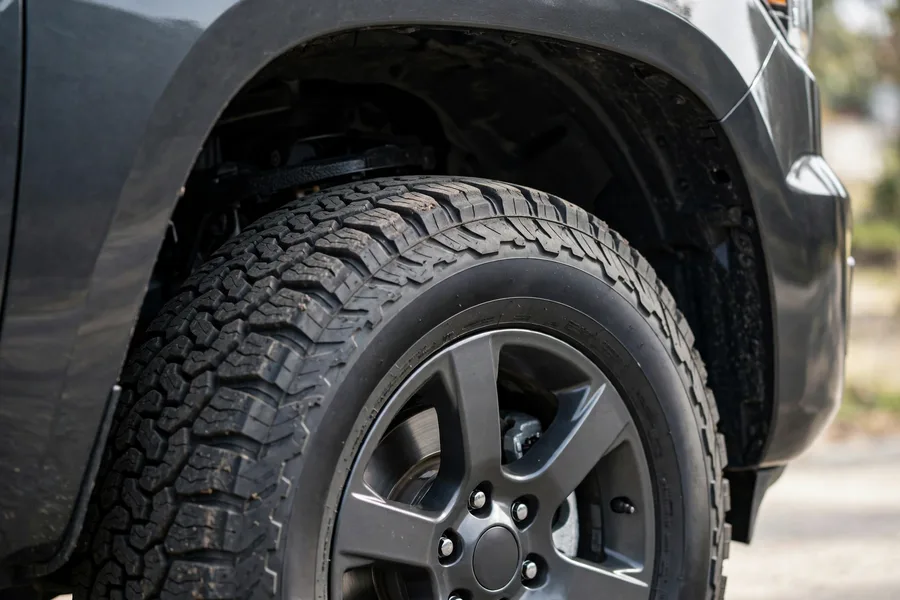
The gap between tread and fender liner is the whole game — a bigger tire spends it.
The three things that decide it
1. Diameter — room above and at the ends
A taller tire fills the wheel well from the inside. Going from a 265/70R17 (31.61") to a 285/70R17 (32.71") makes the tread sit about 0.55" closer to the top of the well and to the front and back edges — exactly where it gets tight when you steer. As a rough guide, every inch of added diameter eats about half an inch of clearance in every direction around the top half of the tire.
2. Width — room on the inside
A wider tire grows on both sides. On the same wheels, about half of the extra width goes inward toward the suspension, control arms and frame, and half outward toward the fender. A +20 mm width step (265 → 285) needs roughly 10 mm more room inside. Inside clearance is usually the first thing to run out.
3. Wheel offset — where the tire sits
Offset decides whether the wheel sits tucked in or pushed out. More negative offset pushes the tire outward: it can cure inside rubbing and cause fender rubbing (and fling more mud) instead. Changing wheels changes the answer even for the same tire size. Run your own before-and-after in the wheel offset calculator.
When rubbing actually happens
Almost never rolling straight on flat pavement. It shows up at full steering lock, under suspension compression (bumps, steep driveways, off-road articulation), or with snow chains fitted. A size that "fits fine" in the parking lot can still kiss the fender liner at full lock on a bump.
Measure your truck in five minutes
1) Turn the wheels full lock left, then right. 2) At each lock, find the tightest spots: inner sidewall to the nearest suspension or frame part, and tread top/front/back to the fender liner. 3) Measure those gaps. 4) Compare them with the change you are planning: the new tire needs about half its diameter increase in extra room around the top, and about half its width increase in extra room inside. Our comparison tool gives you both numbers for any pair of sizes.
What about load range and ride?
Owners often step from a load range C tire to a load range E when upsizing. The E tire carries more and tows steadier, but it is heavier and usually rides firmer and costs a little fuel economy — that is a property of the tire model, not of the size itself. Size math cannot tell you how a specific tire rides; it can only tell you how much room it needs.
The bottom line
No calculator can certify a fit — clearance lives in your specific vehicle, wheels and alignment. But the decision is measurable: know your gaps, know the deltas, and the answer stops being a guess. Start with a pair:
Nominal geometry — method. Last verified November 12, 2026.